

We decided to analyse the German and Polish media to find out what the countries think about the temporarily reintroduced border controls at the German border with Poland. Border controls were introduced on 16 October 2023 and have since been extended until mid-June 2024. We analyzed various articles.
In the German media, we used well-known and trustworthy sources such as tagesschau.de, zeit.de and mdr.de. In the Polish media, the search for trustworthy sources was more difficult due to the past rule of the Law and Justice party (PiS), which meant that the media was not independent, which is required for quality journalism. It is only now, after the end of the PiS government, that efforts to restore journalistic integrity are underway. Notes from Poland is an independent news outlet that couldn’t be included in our analysis due to the absence of a dedicated article specifically addressing border controls between Germany and Poland. However, our media analysis includes articles from other sources such as tvn24, Radio Poznan and Radio ZET.
We analyzed the moods of the two countries with regard to the border controls and found contrasting views.
Common Media Attitude in Germany
In Germany, there are articles that report neutrally on the border controls, articles that report favorably on the border controls that have been introduced, and articles that cast doubt on the effectiveness of these border controls and take a critical view on them.
Neutral reports
The first source that we rely on reports neutrally on the fact that Nancy Faeser (Federal Minister of the Interior and for Home Affairs of the Federal Republic of Germany, SPD) is extending the controls.
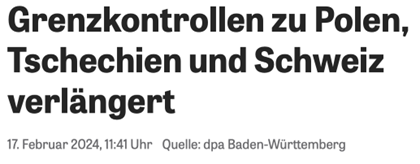
The German central news web portal of ZEIT ONLINE, citing a report from dpa Baden-Württemberg, published an article on 17 February 2024 about the extension of border controls by German Interior Minister Nancy Faeser. The article does not provide the author’s name as it was automatically taken from the Deutsche Presse-Agentur (dpa).
The headline, “Grenzkontrollen zu Polen, Tschechien und Schweiz verlängert”, is direct and factual, indicating that border controls with Poland, the Czech Republic, and Switzerland have been extended. The headline sets a neutral tone, informing readers about the extension without any bias.
The article provides an informative account of the reasons behind the extension of border controls to Poland, the Czech Republic, and Switzerland, as explained by the Federal Ministry of the Interior. The tone remains neutral and factual, focusing on official statements and statistics.
Nancy Faeser, the Federal Minister of the Interior, is quoted saying that the extension is necessary to combat the “ruthless business of smugglers” and to limit irregular migration. The article supports this statement with specific statistics. It also highlights the decrease in monthly unauthorized entries.
The article emphasizes the effectiveness of the controls. The extension of border controls is presented as a necessary measure, reflecting the government’s stance on maintaining security and managing migration.
The article predominantly features statements from government officials, such as Nancy Faeser, and uses terms like “unauthorized entries” and “smugglers,” which convey a sense of legality and criminality without sensationalism. The language is factual and devoid of emotionally charged terms, maintaining an objective tone throughout.
The article does not provide counterarguments or perspectives from other stakeholders, such as opposition politicians, human rights organizations, or representatives from the affected countries (Poland, Czech Republic, and Switzerland). This absence of alternative viewpoints may give the impression that the government’s position is uncontested and universally accepted.
Overall, the article on ZEIT ONLINE provides a clear account of the extension of border controls by the German government, focusing on the reasons and justifications provided by the Ministry of the Interior. It maintains a neutral and factual tone, informing the public about recent governmental decisions and their perceived effectiveness. However, not including counterarguments or perspectives from other affected parties might be a limitation, potentially making the article seem biased towards the government’s viewpoint.
Positive Reports
The second source we refer to reports on the positive consequences of the introduced border controls. On 25.11.2023, Tagesschau.de published an article discussing the significant reduction in illegal immigration following the introduction of border controls by German Interior Minister Nancy Faeser. The author’s name is not disclosed.

The headline, “Bericht zu Grenzkontrollen: Illegale Zuwanderung offenbar deutlich gesunken”, directly communicates the main finding of the article. It suggests a notable decline in illegal immigration, presenting the border controls in a favorable light from the beginning.
The article offers a detailed overview of the decrease in unauthorized entries into Germany since the implementation of stricter border controls with Poland, the Czech Republic, and Switzerland. The tone throughout the piece is optimistic, emphasizing the effectiveness of these measures.
Citing a report from “Welt am Sonntag,” the article notes that data from the Federal Police show a significant drop in the number of daily illegal entries—from around 700 before the controls to fewer than 300 afterward. The report highlights a 40.4% overall decrease in unauthorized entries, with the German-Polish border seeing a particularly sharp decline of 56%.
Additionally, the Federal Police attribute part of the reduction to actions by Serbian authorities at the Hungarian border, which have impacted migration routes into Germany.
The article includes quotations primarily from government officials, supporting the narrative of the border controls’ effectiveness. For instance, Armin Schuster is quoted as saying the results “significantly exceeded expectations.” This endorsement, combined with the statistical data provided, reinforces the article’s positive framing of the border controls.
Notably, the article does not present counter arguments or perspectives from critics. This lack of alternative viewpoints might suggest a one-sided perspective.
The language in the article is straightforward and focused on presenting data. Terms like “unauthorized entries’’ and “notified border controls’’ are used, conveying a sense of legality and order. The reliance on specific statistics and official statements adds to the article’s credibility, emphasizing the effectiveness of the measures without emotional or sensational language.
The article is concise, providing essential information and relevant statistics without extraneous detail. Only one image is used at the beginning, serving to visually introduce the topic but not adding additional context or information.
In conclusion, the article on Tagesschau.de offers a clear, objective and detailed account of the reduction in illegal immigration following the implementation of border controls by the German government. It effectively highlights the perceived success of these measures, supported by relevant statistics and official statements. However, the absence of counterarguments or perspectives from other affected parties could be potentially presenting a biased view in favor of the government’s actions.
Negative Reports
The third source we refer to reports on the negative consequences of the introduced border controls and questions their effectiveness. On 08.11.2023, regional news outlet rbb24 published an article titled “Frankfurt (Oder) und Slubice: Criticism of Traffic Chaos Due to Stationary Border Controls,” addressing traffic disruptions caused by heightened border controls between Germany and Poland. The author’s name is not provided. rbb (Rundfunk Berlin-Brandenburg) is the public broadcaster for the Berlin-Brandenburg region, providing independent journalism. It is a state broadcasting corporation within the ARD.

The headline, “Kritik an Verkehrschaos wegen stationärer Grenzkontrollen,” immediately sets a critical tone, emphasizing the negative consequences of the border controls, specifically the traffic chaos in Frankfurt (Oder) and Slubice.
The article focuses on the adverse effects of the border controls, particularly the severe traffic congestion in the border region. The tone is predominantly critical, reflecting dissatisfaction with how the controls have been managed and their impact on daily life.
The article describes the lengthy traffic jams, with some individuals experiencing waits of up to five and a half hours to cross the border. Augustyniak, a member of The Left party, criticizes the lack of cooperation between the federal government and local authorities, pointing out that no response has been received from the Federal Ministry regarding the costs of the increased police presence.
The article includes multiple quotations from Jan Augustyniak, emphasizing the local frustration with the border controls. Augustyniak also questions the efficiency of the controls in preventing refugees from entering Germany, labeling it a “wishful thinking” of Interior Minister Stübgen (CDU).
By focusing on the local perspective and the direct impact on residents, the article highlights the grassroots level of discontent. This local viewpoint is complemented by calls for a joint German-Polish task force to address the traffic issues, stressing the need for cooperative solutions.
The language in the article is straightforward but carries a critical undertone. Terms like “traffic chaos’’ and “not pleasant’’ convey a sense of frustration and urgency. The repeated references to the prolonged waiting times and the specific criticisms from local politicians underline the article’s negative view of the border controls.
The article is moderately long, providing a thorough account of the situation and the various criticisms leveled against the border controls. It includes only one image at the beginning, which visually introduces the topic but does not add additional context or information.
Overall, the article on rbb24 offers a detailed analysis of the increased border controls between Germany and Poland. It highlights the significant traffic disruptions, dissatisfaction among local residents and politicians, and raises questions about the effectiveness of these measures. The lack of counterarguments or perspectives from government officials could be seen as a limitation, as it presents a predominantly critical viewpoint.
Media Position in Poland
The Polish media report predominantly negatively on the border controls introduced between Germany and Poland or see problems in the border controls that have been introduced, but there are also media that report neutrally on the border controls.
Negative reports

The first Polish source we refer to is an article published by TVN24 Business on March 4, 2024, titled “Co dalej z kontrolami na granicy z Niemcami? Jest deklaracja ministra”, which addresses the ongoing border controls implemented by Germany. The author’s name is not provided. TVN24 is a prominent Polish news outlet known for its comprehensive coverage of domestic and international affairs.
The headline, which translates to “What’s Next with Controls at the Border with Germany? Minister’s Declaration”, sets an anticipatory tone, suggesting forthcoming official comments or actions regarding the border controls. This indicates that the topic is of significant importance and ongoing discussion in Poland.
The article discusses the efforts of the Polish government, specifically Minister of Internal Affairs and Administration Marcin Kierwiński, to persuade Germany to lift the border controls. The tone of the article is diplomatic but conveys a sense of urgency and determination. The article notes that the Polish government intends to convince German authorities to end the border controls by June 15.
The article features quotes from Minister Kierwiński, reflecting Poland’s dissatisfaction with the border controls and its proactive stance in seeking their removal. Key quotes include, “We will try to convince the German side to lift these controls” and “I hope that today in the bilateral meeting with the German minister, we will have the opportunity to discuss this.” These quotes indicate Poland’s clear position against the continuation of the border controls, highlighting an assertive diplomatic approach.
The language in the article is formal and direct, reflecting the seriousness of the issue. Terms such as “lifting these controls’’ and “convincing the German side’’ emphasize Poland’s active efforts and determination.
The article is of moderate length, providing a comprehensive overview of the situation and the Polish government’s stance. It focuses on the textual content, with no visual elements included apart from a video at the beginning of the article that readers can watch instead of reading the text. Additionally, the TVN24 webpage contains numerous advertisements, which can be distracting and may affect the reading experience.
Overall, the TVN24 Business article clearly outlines Poland’s position on the border controls with Germany. The Polish government, represented by Minister Marcin Kierwiński, is portrayed as actively opposing the continuation of these controls and engaging in diplomatic efforts to have them lifted.

On November 15, 2023, Radio Poznań published an article titled “Niemcy chcą przesunąć kontrole graniczne na terytorium Polski,” updated on November 16, 2023. This is the second Polish article we refer to. The article discusses Germany’s proposal to relocate border controls to Polish territory. The author’s name is not provided.
The headline, “Germany Wants to Move Border Controls to Polish Territory,” indicates a contentious proposal, highlighting the potential shift of border management responsibilities from Germany to Poland.
The article situates the migration issue within German domestic politics, focusing on Chancellor Olaf Scholz’s remarks about the need to limit migrant entries. The tone is critical, reflecting Polish concerns about the proposal’s implications for their border security.
Bartosz Grodecki, Undersecretary of State in the Polish Ministry of Internal Affairs, is quoted expressing skepticism about the temporary nature of the controls and predicting their extension. He also disputes claims from the German media about an official request to move the control point to Poland, clarifying that no such request exists.
Grodecki voices concerns that relocating border controls to Poland would impose significant burdens, including potential security risks at Poland’s other borders. Ronny Bergmann of the German Federal Police explains the legal basis for the proposed move, stressing the need for Polish consent.
The article includes only one image at the beginning, visually introducing the topic but not providing additional context.
The article is moderately long, providing a comprehensive analysis of the situation. It thoroughly details the issues and implications of Germany’s proposal, ensuring readers understand the depth of the controversy.
Overall, the article presents a detailed examination of Germany’s proposal to move border controls to Polish territory, emphasizing the logistical, political, and security concerns from the Polish perspective.
Neutral reports

On January 11, 2024 the Polish news website Radio ZET published an article titled ‘’Niemcy przedłużają kontrole na granicy z Polską. ‘Przynoszą rezultaty’’’ about the extension of border controls by Germany. The author’s name is not provided.
The headline “Germany extends border controls with Poland. ‘They bring results’’’ presents the extension of border controls as effective, indicating a positive outcome.
The article reports a decrease in illegal entries into Germany from Poland, the Czech Republic, and Switzerland since the introduction of regular border controls. The tone is factual.
Federal Minister of the Interior Nancy Faeser is quoted emphasizing the positive outcomes of the border controls, indicating governmental support for their continuation. Perspectives from German authorities reflect a commitment to combating illegal migration.
The article is quite short and includes only one image at the beginning, which serves to introduce the topic visually. However, the article contains a significant amount of advertising, which can be distracting for readers.
In conclusion, the article provides a concise overview of Germany’s decision to extend border controls with Poland, framing it as an effective measure for Germany in reducing illegal entries. The focus is on governmental perspectives and factual reporting of statistical data, presenting a neutral stance on the issue.
In summary
To summarize, it can be said that there are contrasting views regarding the border controls. German media reports on border controls are predominantly neutral and not exclusively positive or negative. Polish media report neutrally, but often negatively about the border controls.
RESEARCH | ARTICLE © Linda Kühn and Sara Marino, Jade University of Applied Sciences Wilhelmshaven, Germany
Leave your comments, thoughts and suggestions in the box below. Take note: your response is moderated.
