

Reporters Without Borders published the 2026 World Press Freedom Index, which demonstrates that while Western European countries hold high positions in press freedom, Russia and Belarus rank among the lowest globally. In its research, RSF stated that in these two countries, the authorities use anti-terrorism and anti-extremism laws to prosecute both domestic and international journalists for their work. The claim turns out to be true. Russia and Belarus have legitimized the repression of journalists who publish information unfavourable to the authorities. This systemic assault brings threats to press freedom.
Use of anti-extremism and anti-terrorism laws against journalists
All consulted independent sources agree that anti-extremism and anti-terrorism laws are being used against journalists in both Russia and Belarus, describing these laws as broadly defined and primarily serving as instruments of political control rather than genuine security measures.
The meaning of “regularly”
As a qualitative term like “regularly“ lacks precise metrics, its appropriateness was evaluated by independent sources. They suggest that the use of anti-extremism and anti-terrorism laws against journalists is not occasional, but part of a repeated and long-term pattern. Following an email inquiry, The Office of Belarusian democratic leader Sviatlana Tsikhanouskaya describes the practice as “systematic, not sporadic”. Pavel Slunkin, a Visiting Fellow at the European Council on Foreign Relations (ECFR), argues that in Belarus these laws are applied to “almost all” critical reporting. Similarly, Kristiina Silvan, Postdoctoral Fellow in Eurasian studies at the Finnish Institute of International Affairs (FIIA), considers the term broadly accurate, although she notes that it remains somewhat vague and lacks a precise quantitative definition. Overall, based on the expert interviews conducted to the factcheck, the evidence points to a consistent and structural pattern of repression.
Forms of “criminalization”
Practices of “criminalization” include arrests, prosecutions, and prison sentences against journalists. Other documented measures include pre-trial detention, confiscation of equipment, and trials in absentia. In reply to the request, Pavel Slunkin from the ECFR states that journalists can be detained simply for publishing critical content, with many imprisoned or forced into exile. Kristiina Silvan from the FIIA adds that these measures create a “chilling effect”, driving self-censorship among journalists and audiences.
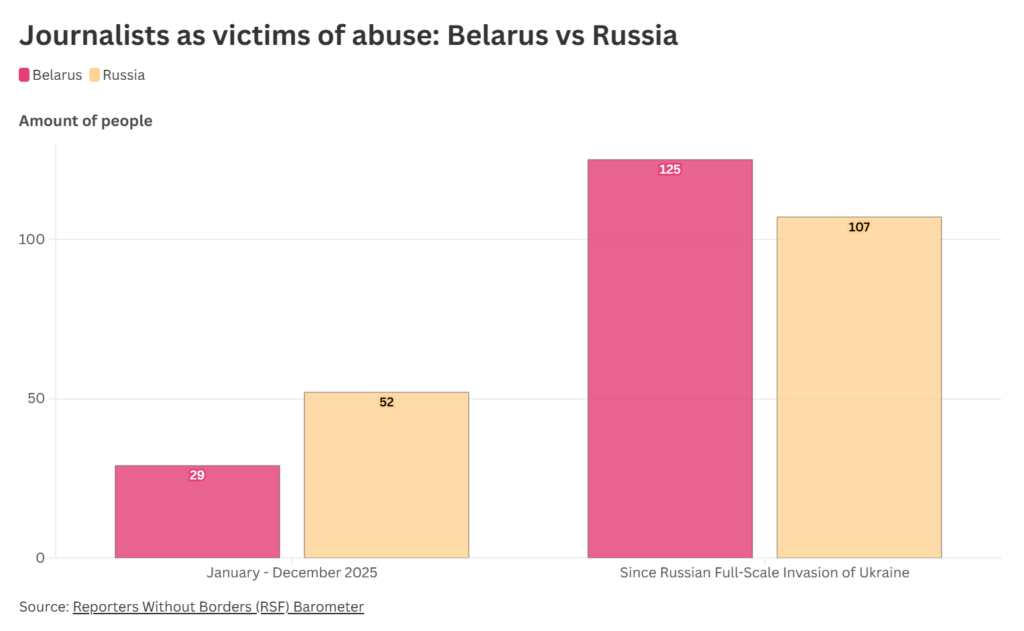
Russia: A Labyrinth of Repressive Laws
The Committee to Protect Journalists (CPJ) states: “The media in Russia has experienced an unprecedented crackdown since the full-scale invasion of Ukraine in 2022”. By the end of 2025, it ranked 172nd out of 180 countries in the RSF’s World Press Freedom Index.
The Justice for Journalists Foundation (JFJ) mentioned in a report they released in March: “dozens of journalists in Russia remain behind bars as a result of their professional activities … In 2025, as in previous years, the overwhelming majority of recorded attacks (774) cases involved the use of judicial and/or economic means”. JFJ notes: “Russia adopted Belarusian-style tactics and criminalized media consumption, introducing criminal liability for knowingly accessing ‘extremist’ content”, while continuing the widespread use of anti-terrorism laws.
According to the JFJ report, the Russian authorities are continuously tightening legislation in the field of freedom of expression: “The Ministry of Justice added 182 individuals and 33 organizations to the ‘foreign agents’ register in 2025 – an overall increase of one-third compared with 2024”. Inclusion on this list requires strict legal compliance, with failure resulting in fines or administrative and criminal prosecution.
The increasing number of arrests, attacks, and additions to the “foreign agents” register demonstrates how the Russian government continues to tighten control over freedom of expression. As a result, reporters face risks for carrying out their work, contributing to Russia’s extremely low ranking in the global press freedom index.
Belarus: Where Journalism is “extremism”
Belarus began to actively strengthen its extremism laws in response to the nationwide protests of 2020–2021. By the end of 2025, this country ranked 165th in the RSF`s World Press Freedom Index.
The Associated Press emphasizes that extremism is the most common accusation used to detain, fine, and imprison citizens with critical views. Even reading independent Belarusian media outlets that are declared extremist and regularly blocked can lead to short-term arrest, while subscribing to their updates is considered “supporting extremism” and is punishable by up to seven years in prison.
Pavel Slunkin, a Visiting Fellow at the ECFR, said in a phone interview: “Since 2020, thousands of organizations, people and their reports, websites have been labeled extremist or even terrorist. They are human rights defenders, independent media, YouTube channels, journalists, even wildlife protection organizations. They [Belarusian authorities] use anti-extremism laws to ban any activity that is not under government’s control or influence”.
According to the Viasna Human Rights Centre, last year Belarusian courts declared 2,107 pieces of informational content “extremist” – from Telegram channels and TikTok accounts to books, websites of international organizations, and even pages containing lists of political prisoners.
Moreover, The Office of Sviatlana Tsikhanouskaya notes the most frequently applied provisions of the Criminal Code: creation of or participation in an “extremist group”, aiding and abetting extremist activities, incitement to hatred and discrediting the Republic of Belarus, as well as administrative liability for “disseminating extremist materials”.
Based on the findings of the factcheck, full-scale restrictions against journalists in Belarus are not isolated incidents but part of a broader institutionalized system designed to maintain government control over information and public opinion, creating a negative impact not only on domestic but also on cross-border journalism.
The evidence strongly supports RSF’s claim that anti-terrorism and anti-extremism laws are regularly used in Belarus and Russia to criminalize reporters’ work. In both countries, these laws are applied not only against reporters but also against ordinary citizens interacting with independent journalism. While Russia relies heavily on anti-terrorism legislation and extensive legal restrictions following its invasion of Ukraine, Belarus uses anti-extremism laws to criminalize nearly all independent reporting and international media cooperation. Based on the factcheck, the claim can be classified as true.
RESEARCH | ARTICLE © Estel Coletas, Autonomous University of Barcelona, Spain; Ilona Stashuk, Mariupol State University, Ukraine; Olivija Pagiryte, Thomas More University of Applied Sciences, Belgium; Alex Kapanen, Haaga-Helia University of Applied Sciences, Finland; Júne van der Ende, University of Applied Sciences, Utrecht, The Netherlands; Salome Turmanidze, University of Georgia, School of Social Sciences, Georgia.
Leave your comments, thoughts and suggestions in the box below. Take note: your response is moderated.


