
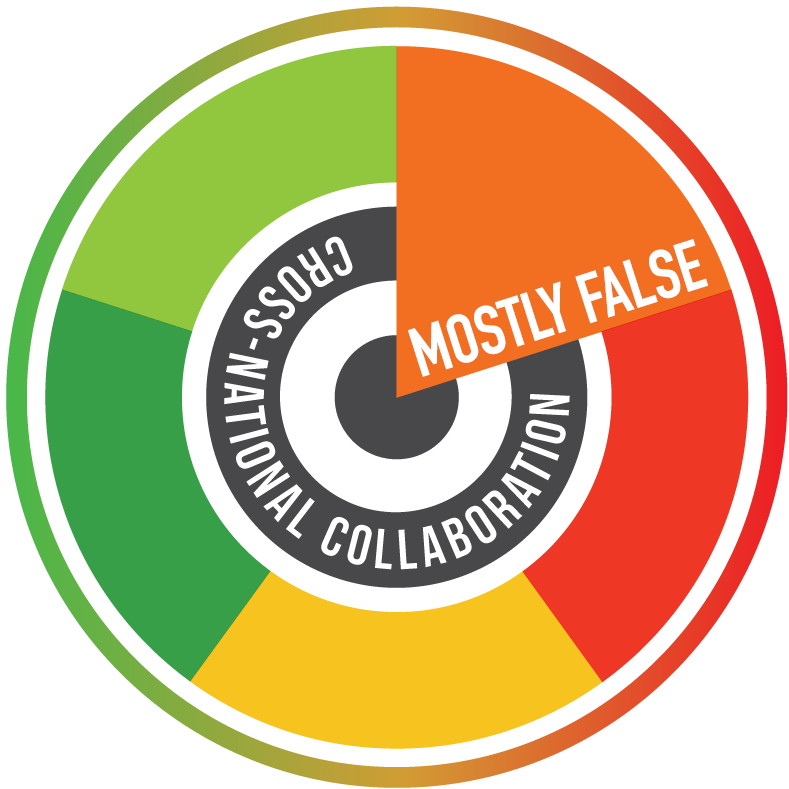
On May 3rd, during the global observance of World Press Freedom Day, United Nations (UN) Secretary-General António Guterres delivered a speech regarding the safety of media professionals, marking the occasion and highlighting the systemic failures that continue to obstruct the work of the press and endanger lives worldwide. In his speech he made the claim: “85% of the crimes committed against journalists go uninvestigated and unpunished: an unacceptable level of impunity.” The claim turns out to be mostly false because it relies on imprecise terminology that broadens the scope and alters the meaning of the underlying statistical data.

The 2024 UNESCO Report
The primary source of Guterres’ statement, confirmed by the UN press office, is the 2024 UNESCO Director-General’s Report on the Safety of Journalists and the Danger of Impunity, with the title: ‘Journalists at the frontlines of crises and emergencies.’
In his statement, Guterres uses the specific wording ‘crimes’ committed against journalists, and they remain ‘uninvestigated and unpunished.’ This is important as it turns out the primary source is in disagreement.
Use of the term ‘crimes’
António Guterres uses the term ‘crimes.’ This word choice suggests that the cited 85 percent impunity rate is out of all criminal offenses against journalists, which can include threats, physical assaults, abductions, arbitrary arrests and so on.
The primary source cites the 85% figure exclusively in the context of ‘killings’ of journalists.
The document also states that UNESCO does not systematically collect data on non-lethal attacks against journalists. By replacing the specific term ‘killings’ with the more general term ‘crimes,’ Guterres changes the meaning of the percentage to cover a broader issue.
Additionally, the claim lacks a defined timeframe, while the primary source specifies that it covers the period of January 1, 2006, to October 31, 2023.
The use of the term ‘uninvestigated’
The Merriam-Webster Dictionary defines the verb ‘investigate’ as “to observe or study by close examination and systematic inquiry,” meaning that the use of the term ‘uninvestigated’ implies that no such examination has taken place which does not correlate with the primary source in which 66% is defined as ‘ongoing/unresolved.’
The UNESCO report uses the data from 1,429 cases, and they came to these numbers:

15% is classified as resolved. These cases are closed, for example through conviction, the death of the suspect or judicial archiving.
66% are still ‘Ongoing or unresolved.’ This category includes cases with active investigations, pending verdicts or acquittals. Since these cases are classified as ‘open,’ active investigations may still take place.
In 19% of the cases no information was received. This category reflects incomplete cooperation by Member States.
The claim that 85% of crimes are ‘uninvestigated’ is therefore not correct.
Justice Delayed does not mean uninvestigated
Another critical element in the UN Secretary-General’s argument that these cases remain uninvestigated is the slogan featured prominently in the UNESCO report: “Justice delayed is justice denied.” In the report, the slogan is used with regard to the median time for case resolution, which is four years, representing a significant delay of justice. UNESCO stated that they used it as part of their “high-level political advocacy efforts on reducing impunity for the killing of journalists.”
According to a UNESCO spokesperson, the current level of global impunity for killings of journalists can be described as both “under-resolved” and “under-investigated,” but not uninvestigated.
During an interview, Lawyer specialized in European law, Elisa Escolà argues that the term ‘unresolved’ would be more accurate than ‘uninvestigated.’ It encompasses both cases that were never investigated and cases that were investigated but in which the perpetrators were ultimately neither found or convicted.
While the term ‘uninvestigated’ has been shown to be methodologically flawed, António Guterres is more correct about the use of ‘unpunished.’ A comparison with the primary source shows that the 85% figure aligns precisely with the ‘impunity rate’ defined by the organization.
Breakdown of the source
UNESCO’s analysis relies on data provided by national authorities; “however, the final determination on a specific case also takes into account any ongoing judicial proceedings taking place in other countries, regional or international courts.” Furthermore, “the Director-General only issues requests for information on the status of judicial and criminal investigations into killings of journalists to States when a journalist has been killed in the territory.”
In total, UNESCO requested national data from 75 countries but received responses from only 49. Although the UNESCO report suggests otherwise, not all included national reports contain data up until 2023. The investigation discovered that the entry for Burkina Faso, for instance, was last updated in 2019. According to a UNESCO spokesperson, a response to the Director-General’s request was received in 2024; however, the information provided did not
address the status of criminal or judicial investigations for all ongoing cases of killed journalists. “Therefore, if no updated information on the specific case of a killed journalist is received, UNESCO does not update the entry on the Observatory of Killed Journalists.”
Previous fact-checking conducted on UNESCO’s reports by independent organizations has shown a tendency to use outdated data that is not representative of the present. The national reports which make up the UNESCO report are based on UNESCO’s Journalists’ Safety Indicators framework. This framework states that national reports should be based on two tools: pre-published material, such as news articles, published statements, and reports by NGOs, and interviews with stakeholders, such as journalists and personnel from relevant organizations. It does, however, preface that in countries with small budgets, interviews
should not be prioritized. This means that national reports, especially those from low-income countries, could be based solely on pre-published materials, making the data even older than the official release of the report.
Comparison of 2024 data
Many sources collect data on killed journalists in 2024, but the results differ. The International federation of journalists (IFJ) says that 122 journalists and media workers were killed in 2024, while UNESCO reported 85 deaths. In addition, the Committee to protect journalists (CPJ) says that at least 124 journalists and media workers were killed, while Reporters Without Borders’ (RSF’s) says that the number was 54, a significant spread of results.
The differences can be explained by the variety of the methodology and the definitions each source uses.
UNESCO defines the term journalist as “journalists, media workers and social media producers who are engaged in journalistic activity”. IFJ and CPJ include journalists and camera operators in their counts, and RSF counted journalists, non professional journalists and media workers.
Conclusion
UN Secretary-General António Guterres’s claim that 85% of ‘crimes against journalists go uninvestigated and unpunished is not entirely without foundation, but contains important inaccuracies in both word choice and data-reliability.
Whilst the 85% figure comes directly from the 2024 UNESCO report, it only applies to the killing of journalists, not to crimes against them in general. Furthermore, the word ‘uninvestigated’ is unprecise, most of the cases within that 85% are actively ongoing.
UNESCO received usable responses from only 49 countries, and not all of those covered the full period up to 2023. Even the basic numbers on journalist killings are contested for 2024, due to varying definitions of who counts as a journalist and the limitations of self-reported government data. This further illustrates how difficult it is to pin down precise figures in this area, making the claim mostly false.
RESEARCH | ARTICLE © Catharina Waterstradt, Elif Sabri, Júlia Oró, Luca Heeren, Wessel In den Bosch, Saimi Juutinen
Jade University of Applied Sciences, Thomas More University of Applied Sciences, Universitat Autònoma de Barcelona, Haaga-Helia University of Applied Sciences, Utrecht University of Applied Sciences
Leave your comments, thoughts and suggestions in the box below. Take note: your response is moderated.
Read the explainer piece to this factcheck.
Read the Blogpost related to this Factcheck.