
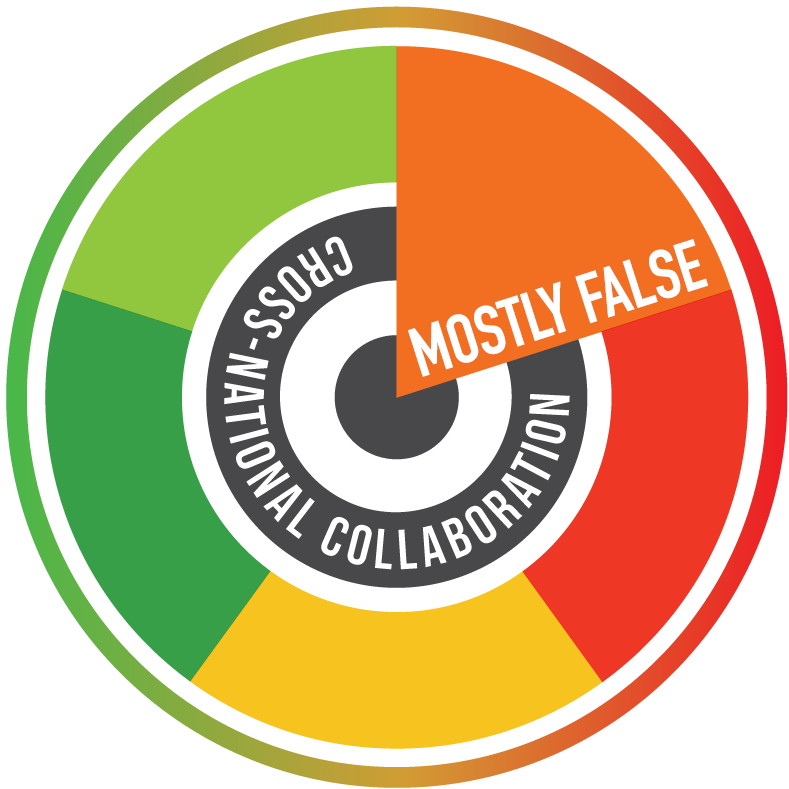
During a public hearing at the European Parliament’s Subcommittee on Tax Matters (FISC) on 6 February 2025, Dutch Commissioner for Climate Action Wopke Hoekstra claimed that only 20% of companies are responsible for around 97% of the emissions. His claim turns out to be mostly false.
Public hearing at the Committee on Tax Matters (FISC)
The Subcommittee on Tax Matters (FISC) has a focus on combating tax fraud and tax evasion. The committee has the right to hold a public hearing with experts if deemed essential for its work on a particular topic. Therefore, a hearing was held on 6 February 2025 to discuss “a coherent tax framework for the EU’s financial sector”. Since taxation also falls under Hoekstra’s tasks, the FISC subcommittee invited him to discuss the main priorities in the area of taxation.

Hoekstra’s hearing was an important step in explaining the planned simplifications under the Omnibus package before the proposals were officially presented on 26 February 2025. The Omnibus procedure proposes to simplify existing EU regulations. According to the European Commission, the goal is to significantly reduce the bureaucratic burden for companies. The regulations on the Carbon border adjustment
mechanism (CBAM) are also to be simplified.
The Carbon Border Adjustment Mechanism (CBAM)
Hoekstra’s claim refers to the question from Vice-Chair Kira Marie Peter-Hansen about what considerations there are for a tax simplification package within the framework of Omnibus. The EU Commissioner answers the question by emphasizing that he wants to simplify the CBAM.
The Carbon Border Adjustment Mechanism (CBAM) is an EU tool to set a fair price for carbon emissions from the production of carbon-intensive goods imported into the EU. When companies import certain products from countries with less regulations, they will have to pay carbon tax as though the products were made inside the EU. The CBAM will apply in its final form from 2026, while the current transition period will last between 2023 and 2025. This gradual introduction of CBAM is aligned with the phasing out of the allocation of free allowances under the EU Emissions Trading System (ETS) to support the decarbonisation of EU industry.
Hoekstra refers to CBAM in his claim by saying: „If you look at all companies that have to deal with CBAM, you will find that roughly 20% are responsible for 97% of all the emissions. Would it then not be smart to leave that roughly 80% off the hook, in terms of the administrative work burden? In my view, it would.”
Which companies are included in CBAM?
Hoekstra’s claim does not refer to all companies, but specifically to the companies covered by the CBAM regulation. According to the CBAM Regulation (EU) 2023/956, this includes imports of cement, iron, steel, aluminium, fertilisers, electricity and hydrogen. These product groups are particularly CO2-intensive, are subject to EU emissions trading (ETS) and have a high risk of carbon leakage. This refers to the relocation of production to countries with less climate regulations.
„Wopke Hoekstra is approaching the situation from a pragmatic standpoint to focus on the largest importers who are responsible for the highest levels of emissions and cut red tape for SMEs. The idea conveyed here aligns indeed with what the European Commission expressed in the CBAM simplification package“, says Mélanie Bruneau, who is an expert in EU and French law at the law firm K & L Gates.
The Commission’s proposal to amend the CBAM Regulation
An inquiry to Hoekstra’s team about where he got his statistics from has revealed that he bases his claim on official data from the European Commission. In a statement, Celia Dejond, his policy assistant, answered: “Data collected to date indicate that a limited number of importers account for more than 99% of greenhouse gas emissions embedded in imported goods. With the transitional period, we have real customs data even if CBAM payments will only come in 2026.”
The data comes from the Commission’s proposal to amend Regulation (EU) No. 2023/956 with a view to simplify and strengthen CBAM.
The proposal was made because the burden of complying with CBAM regulations is very high for EU importers of small quantities of CBAM goods. The problem only affects the four CBAM sectors of iron, steel, aluminium and cement. According to the EU Commission’s report, customs import data from the first year of the CBAM transition period (Q4 2023 to Q3 2024) for these four sectors show that around 80% of CBAM importers accounted for only 0.1% of all imported emissions. In addition, only 10% of importers were responsible for more than 99% of emissions.

On 22 May 2025 , Parliament voted in favour of simplifying the CBAM Regulation, so that 90% of importers would be exempt from the rules.
„The CBAM scope will be limited to the largest importers because those are responsible for almost all the CO2 emissions. This was also justified by the European Parliament when it explained the Omnibus package to say that the CBAM environmental goals will be maintained with 99% of total emissions from imports of iron, steel, aluminium, cement and fertilisers still covered“, explains Bruneau.
According to the EU, the environmental targets remain achievable, as 99% of CO2 emissions from imports of iron, steel, aluminium and cement would still be covered. Hoekstra made this public at a meeting a day before.
The energy and hydrogen sectors cause the most emissions
In contrast, the problem of most occasional importers does not apply to the two CBAM sectors of electricity and hydrogen. Rather, the electricity sector is characterised by the importation of large quantities by individual importers. The hydrogen sector is characterised by a very small number of importers. The analysed customs data show that there are only 64 importers of hydrogen in the EU, which together already account for 92% of the total emissions of the hydrogen sector.
For these reasons, hydrogen and electricity are excluded from the Commission’s proposal to exempt occasional importers of small quantities of CBAM. According to the Commission’s report, several Member States have presented similar results based on the analysis of their national customs data.
Few entities are responsible for the majority of emissions
The Carbon Majors Report (2024) also indirectly confirms the basic principle of Hoekstra’s statement: A large proportion of CO2 emissions are attributable to a small set of entities. The specific figures are not identical, but similar to Hoekstra’s claim. According to the report, 80% of global emissions from 2016 to 2022 can be traced to just 57 companies and state-owned production units (of 117 active companies considered). The long-term historical perspective (1854–2022) also shows that more than 70% of global CO2 emissions come from just 78 entities. The Carbon Majors Report is based, among other things, on an international study that shows that almost two-thirds of total industrial CO2 emissions can be traced back to 90 major carbon producers.
In March 2025, the Carbon Majors Report of 2023 was updated, and the latest data also shows that only a few producers are responsible for most emissions. The updated report states that 50% of global CO2 emissions in 2023 came from just 36 entities in the energy sector.
Similarly, a study by Richard Heede (2019) of the Climate Accountability Institute, reported by The Guardian, found that 20 companies can be directly linked to more than a third of all greenhouse gas emissions. Between 1965 and 2017, these companies contributed to around 35% of all energy-related emissions. This also supports Hoekstra’s claim, even on a global and not CBAM-specific level.
State-owned entities produce more emissions than private companies do
Contrary to the Guardian’s interpretation (“Half of world’s CO2 emissions come from 36 fossil fuel firms, study shows”), however, it is not so much private companies that are responsible for the main emissions, but above all state entities. While in 2023 investor-owned companies produced 24% of the emissions state-owned entities were responsible for 53%.

And since the Paris Climate Agreement came into force in 2016, the Carbon Major Report records a stagnation or even a decline in CO2 emissions from investor-owned companies, while emissions from state-owned companies and governments are still growing.

Possible risks of the new CBAM regulation
Hoekstra claims that it is „smart to exempt around 80% of companies from the CBAM administrative burden.“ According to expert Bruneau, this is associated with the risk of companies splitting into subsidiaries and importing more quantities than permitted. „Situations where operators slightly modify their goods or artificially split shipments to circumvent the obligations cannot be excluded,’ she explains.
„I believe that the European Commission will engage with the relevant national authorities to establish an effective system that prevents abuse or circumvention practices, since some importers can undoubtedly be creative,” adds Bruneau. With more companies potentially falling out of scope with the omnibus simplification package, competent authorities will certainly implement strong enforcement mechanisms and sanctions to tackle any abuse or circumvention strategy by importers.
“Then it depends on the seriousness of the offence and whether it is a negligent, intentional or repeated offence. That falls within the role of the enforcement authorities. I think this will be one of their tasks and challenges,” says the expert in EU law.
Conclusion
In short, EU Climate Commissioner Wopke Hoekstra claimed that around 20% of companies affected by CBAM are responsible for 97% of emissions. Official data from the EU Commission’s proposal to amend the CBAM regulation confirm his in principle, even if the actual figures differ slightly. According to the European Commission, around 80% of CBAM importers accounted for only 0.1% of all imported emissions. In addition, only 10% of importers were responsible for more than 99% of emissions.
The scientific data from international studies support Hoekstra’s argument that it makes economic and administrative sense to focus the CBAM regulation on the perpetrators with the highest emissions. His statement “to leave roughly 80% off the hook, in terms of the administrative work burden” can therefore be mostly confirmed.
Apart from that, the term company is misleading. As the data on which the Carbon Majors Report is based shows, it is not primarily private companies that are responsible for most CO2 emissions. Rather, it is primarily state entities that continue to cause by far the most CO2 emissions, even after the Paris Climate Agreement came into force.
Hoekstra also speaks very generally of “all companies that have to deal with CBAM” in his claim. Thus, his statement implies that all companies subject to CBAM across all sectors are equally involved in the 20%. However, the Commission’s analysis shows that most CO2 emissions are caused by imports from the electricity and hydrogen sectors. The CBAM sectors of iron, steel, aluminium and cement are excluded. For these reasons, Hoekstra’s statement can be categorised as mostly false.
RESEARCH | ARTICLE © Alina Klass and Hannah Walter | Hochschule der Medien (Stuttgart, Germany), Rasmus Kaste | Haaga-Helia University of Applied Sciences (Helsinki, Finland), Louis Wouters and Vicente Hovelson | Thomas More University of Applied Sciences (Mechelen, Belgium), Stanzen Jelsma (Hoogeschool Utrecht University o Applied Sciences)
This factcheck was produced during the Blended Intensive Programme Climate change Lab at Universitat Autònoma de Barcelona, Spain.