
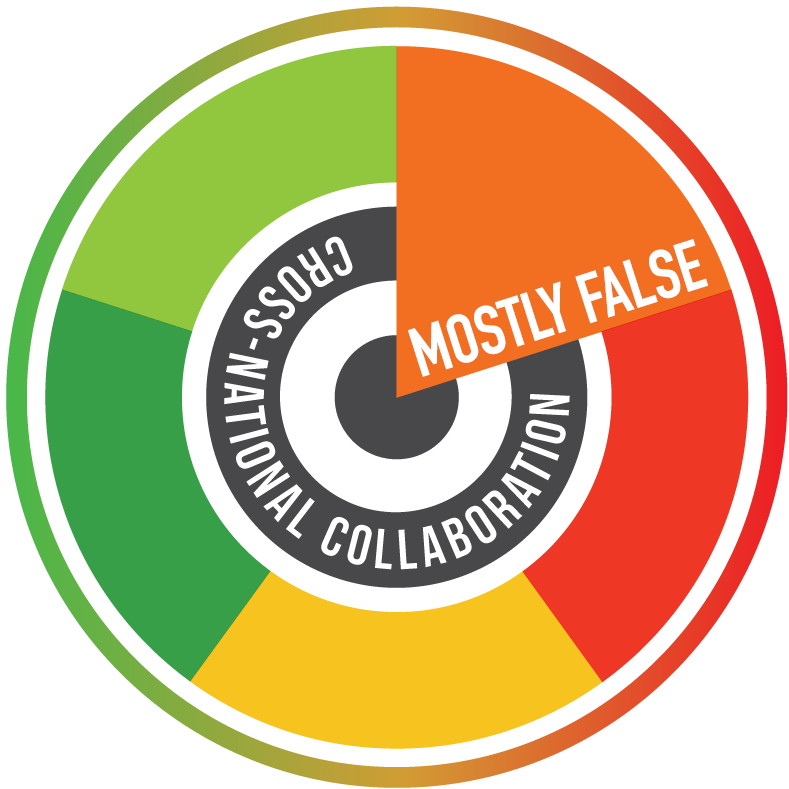
An article by “Al Jazeera” from March 2026 claims that “more journalists have been killed in Gaza since the Gaza war began on October 7, 2023, than in the US Civil War, World Wars I and II, the Korean War, Vietnam War, the wars in the former Yugoslavia and the coalition invasion of Afghanistan – combined.” This claim can be assessed as mostly false.
This fact-check focuses on the two world wars, as they have the highest total number of journalist casualties. A precise casualty count for either war can not be established due to incomplete historical records and inconsistent definitions. However, the original claim can still be disproven due to misquoted datasets and methodological errors.
The claim dissected
The Al Jazeera article quotes “Brown University’s Costs of War project” as a source for the claim. It refers to the report “News Graveyards: How Dangers to War Reporters Endanger the World,” published in April 2025 by researcher Nick Turse. It is the original source for the claim and was also quoted by the United Nations and other international media outlets.
The claim in the report is based on a combination of multiple sources. The figures for journalists who died in the world wars come from the American organisation Freedom Forum, which has a database called “Journalists Memorial” that lists journalists who died covering the news between 1837 and 2019.
The data on killed journalists in the Gaza War is based on an Al Jazeera article, which sources its information from a Palestinian organisation called the Shireen Observatory, and a database from the Committee to Protect Journalists (CPJ).
Why Gaza and the world wars can’t be comparedGaza and the world wars can’t be compared
At its very core, any comparison between the war in Gaza and the world wars is inherently flawed. Definitions about who qualifies as a journalist are inconsistent, the data is incomplete, and the context is inherently different.
Brown University’s study clarifies that it includes media workers such as translators, drivers, and fixers among journalists killed in Gaza, based on the data from the Shireen Observatory and CPJ.
The same definition is not applied to journalists killed in the world wars, and a universally standardised definition of a journalist didn’t exist at the time, making any comparison methodologically unsound.
In this fact-check, a journalist is defined according to the Geneva Conventions, which state that journalists are equated with civilians. A journalist loses their status as a civilian as soon as they take up arms. However, this definition cannot be reliably applied to WWI and WWII datasets, as some listed journalists were armed, and it is not possible to determine which individuals were and which were not.
Another problem arises from the fundamentally different nature of the compared conflicts. The world wars were fought on a global scale across vast front lines, whereas the war in Gaza is mostly concentrated within the 365 km² Gaza Strip.
According to Dr Ute Daniel, Professor of modern history at the Technical University of Braunschweig, quantitative comparisons between these wars are not meaningful. She argues that working conditions for journalists are “fundamentally distinct.”
“During the world wars, journalists were treated almost like protected commodities; they were kept in designated press camps behind the front lines – never in the immediate vicinity of the front itself,” she told EUfactcheck.
Daniel emphasised that journalists working in Gaza live in the middle of the war zone, as the local staff are the only ones permitted to be on the ground.
“This is a truly insane situation, one in which the death toll is naturally far higher than it was during the world wars.”
69 journalists killed in both world wars?
The “Costs of War” report cites a total of 69 journalists killed in the world wars combined, based on the Freedom Forum’s Journalists Memorial database.
Freedom Forum’s Chief Outreach Officer, Jonathan Thompson, stated that “the database was not designed to function as a comprehensive historical record of all journalists killed in conflicts. […] The data should not be used as a complete basis for quantitative comparisons across wars or eras.” He also clarified that the database hasn’t been updated since 2019.
According to Thompson, the Journalist Memorial’s mission is to “illustrate the risks faced by the profession globally.” The database only provides a representative list of mainly killed allied journalists, listing only two journalists from the USSR, and none from Germany or Japan.
In conclusion, the true number of journalists killed in the world wars is almost certainly higher than the number given in the study.
Available data on WW1 remains incomplete and unreliable
There is no reliable database that systematically documents journalists killed during WW1. Casualty records from the period are often incomplete and do not list journalists as a separate category.
The majority of documented cases involve journalists who had been enlisted in the military and were acting as soldiers at the time of their deaths, excluding them from the definition of a journalist following the Geneva Conventions.
“It is completely clear, and indeed unrealistic, to expect that you will ever find more precise figures. There simply aren’t any,” said Daniel.
However, this investigation identified several names missing from the Freedom Forum’s Memorial. Among them: Elbert Hubbard and Patrick Llewellyn Jones, journalists from the United States, who died in 1915 when the RMS Lusitania was sunk, and Diran Kelekian, killed in 1915 during the Armenian Genocide.
World War II
During WW2 there were no international organisations that systematically recorded the deaths of journalists. Available data does not allow for an accurate figure, and any number cited here should be approached with caution, as most sources are either unreliable or may include armed journalists who do not fit the definition under the Geneva Conventions.
Journalism historian J.M. Hamilton mentions 49 American and 18 British newsmen who lost their lives reporting on the war in his book Journalism’s Roving Eye: A History of American Foreign Reporting. The National Press Club of Australia lists 16 Australian war correspondents who died in WW2.
On the Soviet side, the estimates of journalists killed vary widely. Sources in the USSR, and later Russia, have cited figures ranging from 16 to 1,500. At the soviet newspaper Krasnaya Zvezda alone, 16 war correspondents were confirmed killed.
Historian Brandon Schechter, in his book The Stuff of Soldiers: A History of the Red Army in World War II through Objects, mentions 225 deaths of the USSR’s war correspondents.
According to the Japanese book, Japanese War History: War Correspondents, 298 war correspondents died in the Sino-Japanese War and the Pacific War combined. We cannot access this book, but the figure is cited in multiple encyclopedias, such as the Britannica International Encyclopedia (Kotobank).
These casualties count only journalists who died directly in war. Freedom Forum’s dataset also includes journalists who died during wartime. When including journalists who died during wartime in the Second World War, the number increases even further.
According to the World Holocaust Remembrance Centre Yad Vashem, at least 1.232 journalists were killed during the Holocaust. During the German occupation of France, about 400 resistance members operating an underground network of printing presses were killed or deported (Musée de la Résistance Nationale).
The Gaza War
Brown University’s Cost of War report quotes 232 journalists and media workers killed in Gaza. This figure is not necessarily false, but should be treated only as a rough estimate.
Due to the fog of war, journalists’ deaths can be both under- and overcounted, and the inclusion of media workers in the figure remains misleading when compared to the world wars.
Sources like the CPJ, Shireen.ps, the IFJ, and the UN report between 148 and 242 casualties. However, they utilise different definitions of a journalist and different geographic scopes. Nevertheless, the key issue is not the stated number itself but the unsound comparison, which conflates different contexts and definitions.
The challenge of correcting false information
Dr Marten Risius, Professor of Digital Society and Online Engagement at Hochschule Neu-Ulm, said a major problem for fact-checkers is that they can only respond to misinformation after it has already been spread. He highlighted that in times of declining trust in the media, it is ever more important to get the facts right the first time.
“Journalists are just like scientists: one should really attempt to consult the primary source,” he said.
Conclusion
The claim that more journalists were killed in Gaza than in both world wars combined is mostly false.
It relies on a flawed comparison between fundamentally different conflicts and inconsistent definitions of who counts as a journalist. Adding to that is the misuse of the Freedom Forum’s Journalists Memorial database, which, as a non-comprehensive record, is not a valid dataset for comparison.
Historical evidence indicates that the number of journalists killed during the world wars is likely significantly higher than the figure used in the claim, but exact totals cannot be reliably established due to missing records and inconsistent definitions.
The original claim also includes casualties from the US Civil War, the Korean War, the Vietnam War, the wars in the former Yugoslavia, and the coalition invasion of Afghanistan, which only weakens the claim further when considered alongside our findings.
Because of these methodological limitations and incomplete data, the comparison is invalid, and the claim is therefore mostly false.
RESEARCH | ARTICLE ©Veeti Kajastie, Eva Polders, Jan Rehaag, Pau Iglesias Gispert, Vlada Linichenko, Marius Moch
Haaga-Helia University of Applied Sciences, Finland, Utrecht University of Applied Sciences, Netherlands, Thomas More University of Applied Sciences, Belgium, Universitat Autònoma de Barcelona, Spanin, Borys Grinchenko University Kyiv, Ukraine, Jade University of Applied Sciences, Germany
Leave your comments, thoughts and suggestions in the box below. Take note: your response is moderated.
There is also a Blogpost about the factchecking process to this article.