

In a speech released by the United Nations, the Secretary-General António Guterres made a mostly false statement on May 3, 2026, for Press Freedom Day. “Eighty-five percent of the crimes committed against journalists go uninvestigated and unpunished: an unacceptable level of impunity,” he stated.
Why is the percentage of crimes against journalists difficult to measure?
Assessing the number of crimes committed against people is a tedious task, and the methods for such evaluations vary.
Hence, there are many background assumptions to explore when examining the claim that “eighty-five percent of the crimes committed against journalists go uninvestigated and unpunished.”
It is safe to say that the number of crimes reported to authorities does not match the true number of crimes committed in any society.
In very specific cases, more crime might be reported to and recorded by authorities than the true number would be, which could be due to unfounded claims about crimes that never occurred.
However, in a wider perspective, it’s exactly the opposite: many more crimes are being committed than what gets reported to authorities.
The troubled report
Guterres based his statement on a 2024 report by UNESCO on the killings of journalists. In it, the UN states that “eighty-five percent of journalist killings remain unpunished worldwide.”
The Secretary General quoting this report, raises multiple questions.
The report talks about an impunity rate of 85 percent for killings, not crimes, which is the term Guterres used in his statement.
This is not the only problem; however, the report itself also reveals several flaws in the methodology to reach its conclusion.
The report bases its impunity rate on reports provided by the countries themselves. UNESCO requested data from 75 different states, of which only 49 responded. These 49 countries, out of a total of 193 member states, do not provide a complete enough picture.
Another problem is that the states providing the reports must be truthful and complete in what they provide. In reality, these reports often seemed outdated and incomplete.
Why use “crimes” instead of “killings” and how the media takes over the narrative
The media frequently replicates and condenses information for easy consumption. Direct quotes from the Secretary-General tend to appear in headlines with only limited explanation.
Such cases lead audiences to trust the reported numbers, largely because the UN is considered a reliable source. This can be misleading, as the statement may seem to refer to all crimes against journalists, while the cited report focused only on killings.
For instance, The Daily Post, The 21st Century Chronicle, and Peoples Gazette have quoted Guterres, but their briefs failed to clarify that his statement was based on specifically killings —not all crimes.
The use of broader terms shows how meaning can shift in news reporting through simplification. In consequence, this approach can blur the important distinctions and leave the door open for a broader interpretation of the issue than the original source intended.
The usage of the word “crimes” instead of “killings” intended by the report also highlights a flaw in the communication from the UN and Guterres, effectively downplaying the report through simplification of terms, and portraying wrong information to the outside world.
When did Guterres use “crimes” and “killings” before?
Previously, António Guterres mentioned these terms in public speeches dedicated to Press Freedom Day and International Day to End Impunity for Crimes Against Journalists.
Over the last three years (2024-2026), he defined crime as both physical abuse and legal and mental pressure. For instance, the intimidation, surveillance, censorship, harassment, detention, physical assault, and killings were mentioned. It can be said that the usage of words by Guterres around this topic has been more nuanced in the past years than in the statement on May 3 2026.
What word means what?
According to the UN and other institutions, the words “crime” and “killing” also hold different meanings, thus bearing different weights when being used.
A crime, according to the UN, doesn’t only cover “killings” but also includes censorship, legal harassment, physical attacks, and other kinds of personal attacks. For a crime to be especially against journalists, it has to be committed because of their professional activity.
Killing is the act of homicide, which is seen as a crime under international law. It does not encompass other crimes.
Journalists are defined by the UN as “journalists, media workers, and social media producers who are engaged in journalistic activity.” This is a very broad definition of the profession and can paint warped pictures in reports.
Impunity is seen as “injustice to the victims, an assault on press freedom, and an invitation to further violence.” The term is, however, also used to refer to cases that are unresolved or ongoing.
The “Dark Figure of Crime”
The example of António Guterres and UNESCO shows that simplifications can mislead readers if the methods underlying statistical figures are not explained transparently.
In the UNESCO report, the total number referred only to killings of journalists reported by participating states. However, in Guterres’ statement, this could easily be interpreted as reflecting all crimes against them.
“Global data on impunity for all crimes against journalists is, to our knowledge, unfortunately not available,” Evelien Wijkstra, Director of Policy and Advocacy, Free Press Unlimited, said.
The expert further explained that crimes against journalists vary widely, from physical attacks to online threats, and are often not systematically recorded. As a result, reliable global datasets mainly exist for killings of journalists rather than for all crimes committed against them.
The report cannot demonstrate the full extent of such crimes, as some cases remain beyond official records.
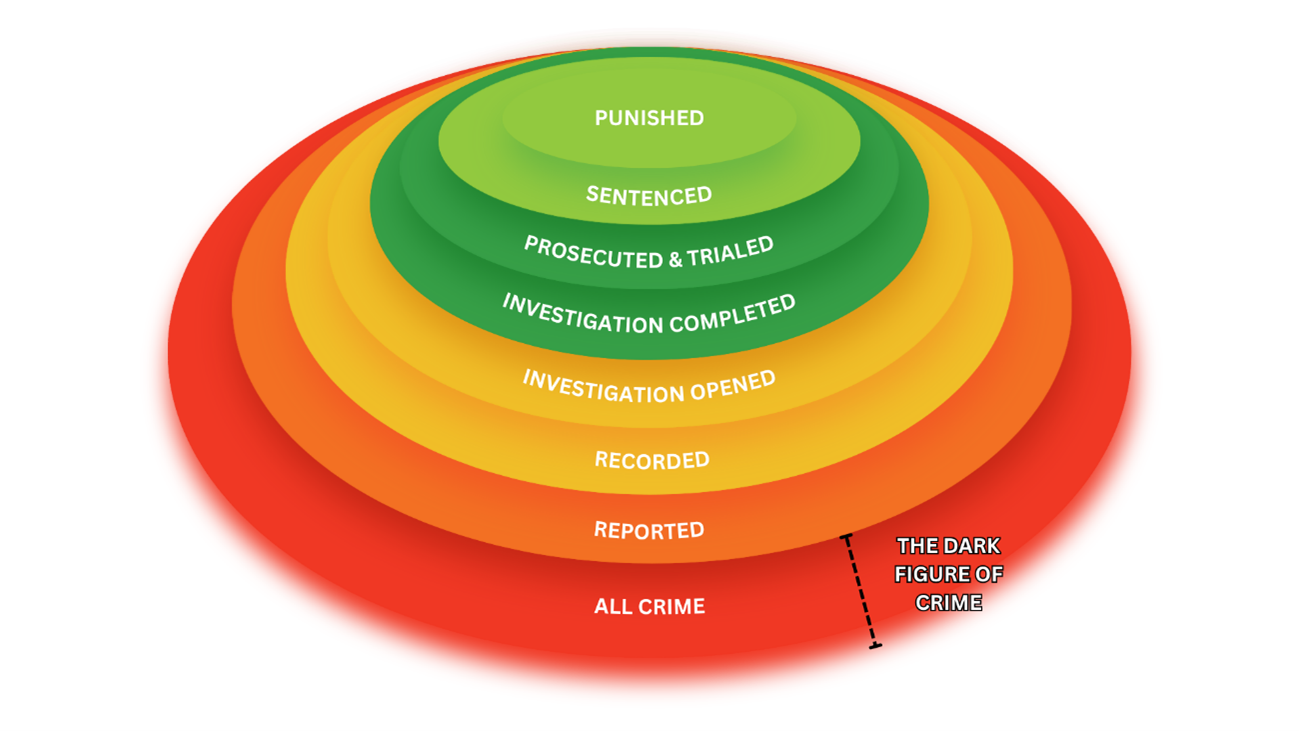
The “dark figure of crime” refers to offenses that never appear in official statistics because they are not reported or recorded. Since these cases remain outside the criminal justice system, they rarely lead to prosecution. As a result, any attempt to measure the overall scale of crime will inevitably remain incomplete. Such cases also contribute to impunity, as an unreported offense never reaches court.
As the Venn diagram below illustrates, crime statistics based solely on officially recorded cases cannot capture the full scope of crime.
Broader estimates can be obtained through victim- and self-report surveys, in which victims and offenders provide information about crimes they have experienced or committed. Researchers then aggregate these samples to estimate crime rates.
So, what now?
Although crimes against journalists remain a serious threat to freedom of speech, accurate statistics are difficult to determine because numerous cases are never officially recorded and therefore remain unpunished, due to never even entering the judicial system.
To reduce the risk of speculation, it is important to use precise wording and clarify that such figures should be treated as approximate estimates rather than exact numbers.
EXPLAINER | ARTICLE © Aagje Van Raemdonck, Itsván Rytkönen, Yulianna Yermoratii, Nick Vink, Otari Tvaliashvili, Louis Wouters
Thomas More University of Applied Sciences, Mechelen, Belgium, Haaga-Helia University of Applied Sciences, Helsinki, Finland, Boris Grinchenko University, Kiev, Ukraine, Utrecht University of Applied Sciences, Netherlands, Jade University of Applied Sciences, Wilhelmshaven, Germany
Leave your comments, thoughts and suggestions in the box below. Take note: your response is moderated.
Read the factcheck to this article.


