

“And then we must also acknowledge that a significant proportion of this violence originates from immigrant communities in the Federal Republic of Germany.” On 25 March 2026, the German Bundestag debated the issue of violence against women in the wake of a high-profile case of sexual violence against the actress Collien Fernandes. Chancellor Friedrich Merz responded to questions from the “Greens” and “CDU/CSU” parties with the statement quoted above. The debate was interrupted by heckling from various parties and also sparked a heated discussion, which is why we consider this topic relevant for this fact-check. After examining a number of reports and expert statements, we have concluded that the Chancellor’s statement cannot be fully endorsed in the context of the debate.
How we clarify uncertain terms through definitions
Firstly, we must clarify the terms used by Merz, as without definitions and context these terms and the context are difficult to grasp. Upon request, the Chancellor has not provided us with any definitions of these terms. Below, we set out definitions of the terms, which we will use to examine the statement. According to the Expert Council on Integration and Migration, the term “immigrant” generally covers all forms of cross-border migration. This includes temporary stays such as a semester abroad, but not tourism. There is no specific legal definition. Furthermore, “immigrant” and “migrant” are often used as synonyms, although the second term refers to people with permanent residence. According to the Bundeskriminalamt (BKA, Federal Criminal Police Office), “immigrants” are recorded in the annual Polizeiliche Kriminalstatistik (PKS, Police Crime Statistics) under the categories “asylum seekers”, “persons entitled to protection and asylum, contingent refugees” “tolerated status” and “illegal residence”. The term “significant” chosen by Merz is a flexible and subjective description that can be interpreted in different ways. The dictionary defines the word as “quite large” or “considerable”. We assume it refers to a “noteworthy” amount. To put things into context, it is also important to note that non-German suspects are clearly over-represented in the statistics on violence – accounting for 42.9 per cent – compared with their actual share of around 15 per cent of the German population, as shown in the following figures. Finally, a definition of “violence” is required.
Given the wide scope for interpretation of the statement, we aim to provide a general overview of violence against women – both analogue and digital – in Germany. Merz’s statement was made in the context of digital sexual violence as a trigger. Digital violence describes the perpetration of various forms of violence, such as blackmail or humiliation, through technical devices and digital media. Sexualised violence includes sexual acts that do not take place consensually. During the debate, Merz expanded the term to include “violence in real life”, thereby extending the scope of interpretation for the concept of violence. Violence against women in general describes violent physical or psychological acts committed on the basis of gender.
Figures on violent crime do not suggest that immigrants are overly prone to violence
We will therefore now examine figures from the PKS in order to gain an overview and be able to comment on the matter. A spokesperson for Merz cites the Federal Situation Report on ‘domestic violence’ from 2023 and the report on ‘gender-specific offences against women’ from 2024 as the sources for his statement. The latter refers to data on suspects in sexual offences, specifically rape, sexual harassment, coercion and sexual assault. To ensure our figures are as up to date as possible, we restrict ourselves to this report. 97.9 % of suspects are male. Almost half (47.1 %) are under 30 years of age. In cases of domestic violence, men account for 89.2 %.
The 2024 Annual Report also specifically listed digital violence for the first time, which includes, for example, stalking, threats and images that violate a person’s privacy. Most of the suspects come from the victims’ immediate circle. This is also confirmed by Dirk Peglow, Chairman of the Federation of German Criminal Investigators, in an interview. He went on to say: “Violence, or the commission of criminal offences in general, is not primarily a migration-related phenomenon; rather, when I speak of violence against women, it is a problem affecting society as a whole that we face in Germany.” As with the crimes mentioned so far, the majority of suspects in cases of digital violence are male (79.5 %), 76.2 % of them German.
As the Chancellor’s press officers also refer to statistics from the BKA, we have asked the BKA for tables providing information on the nationality, age and gender of suspects in cases of sexual violence in Germany over the last three years. The BKA states that “sexualised violence” is not covered by this term in the PKS. The BKA itself refers to PKS code 110000: “Offences against sexual self-determination: Sections 174, 174a, 174b, 174c, 177, 178, 184i and 184j of the German Criminal Code (StGB)”. Based on this breakdown, the figures for 2025 are as follows:
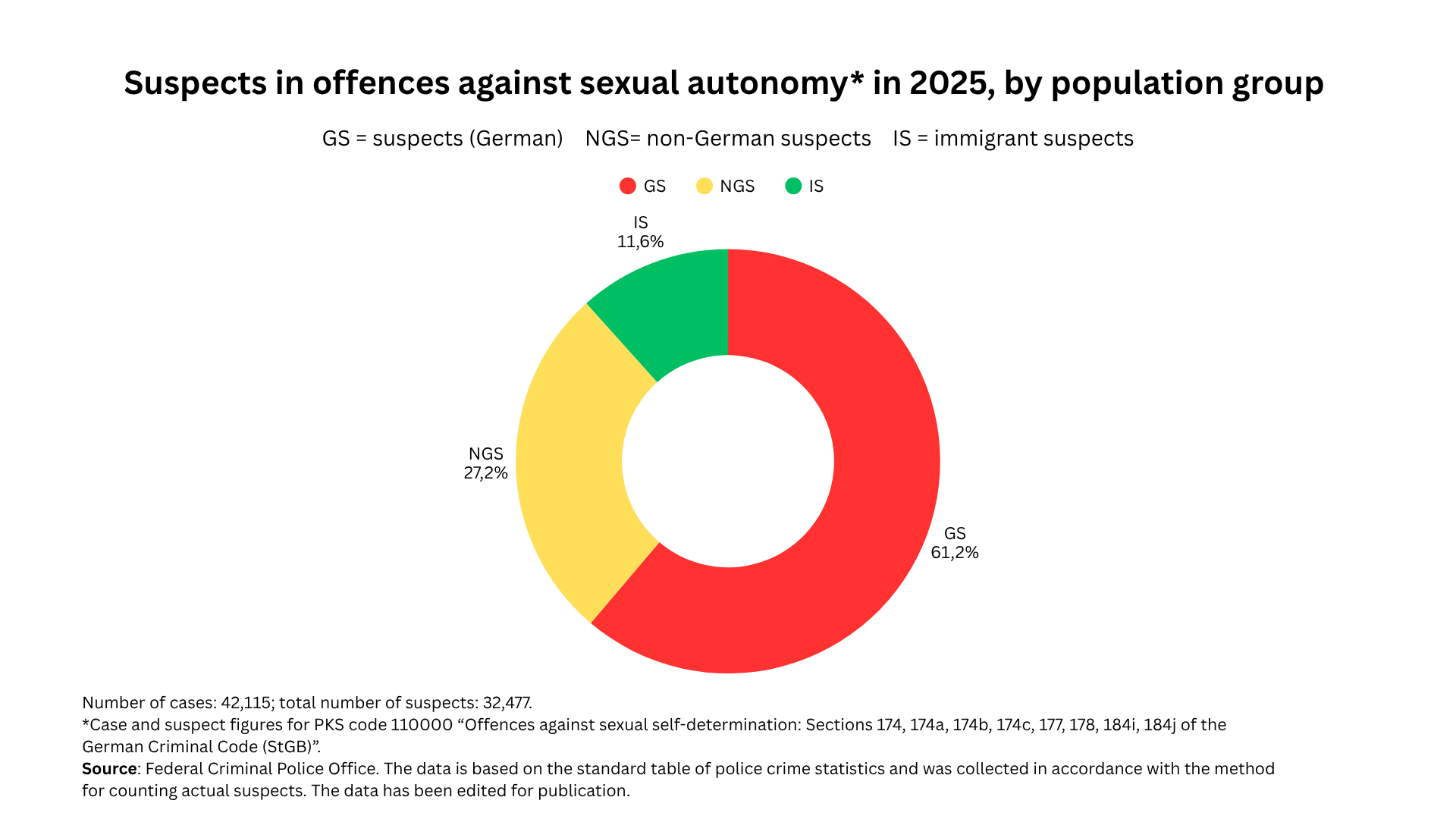
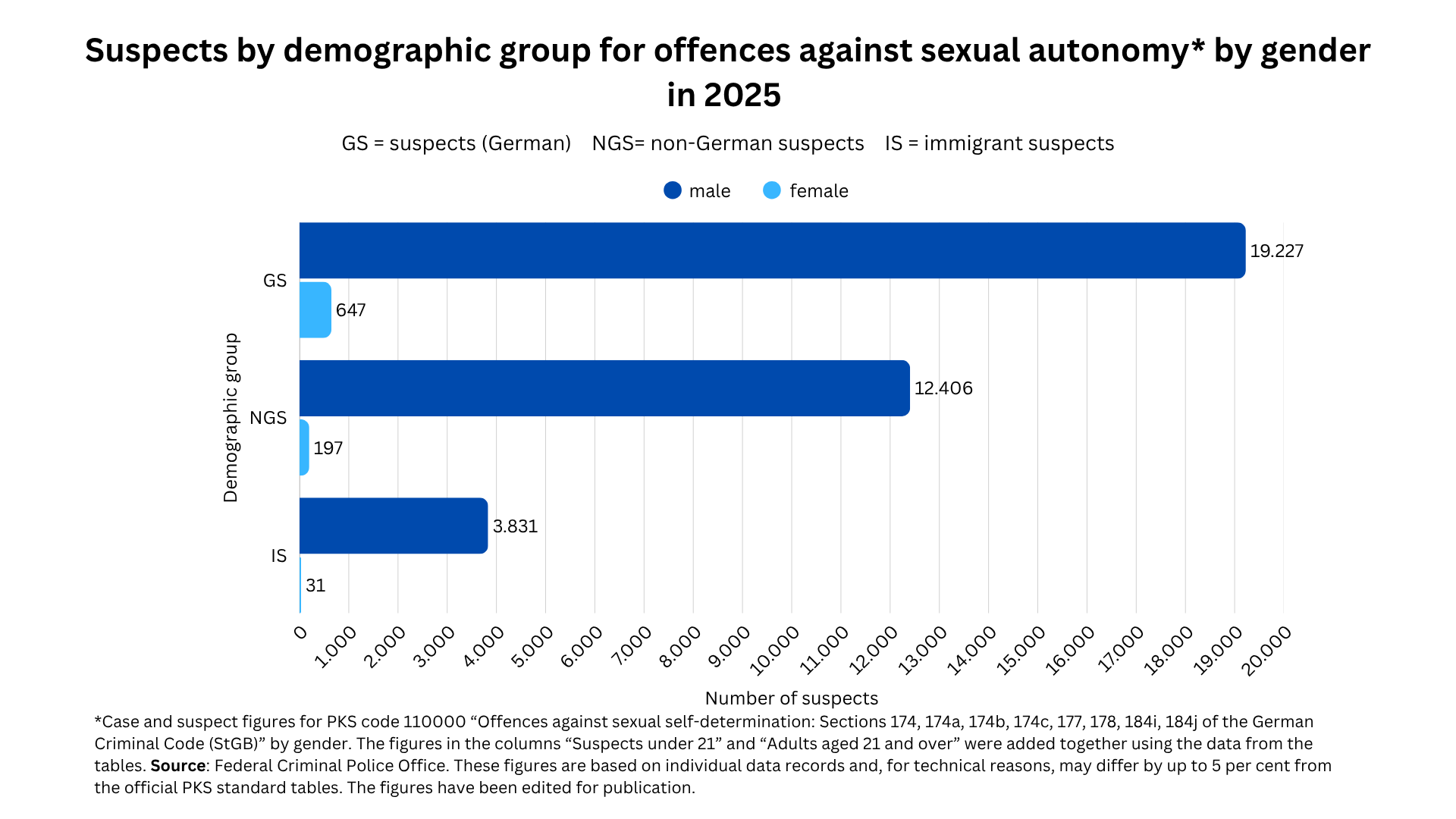
It should be borne in mind that in the Federal Situation Report, to which the Federal Government’s Press Office also refers, suspects are classified only as ‘German’ or ‘non-German’. The explicit term ‘immigrants’, used by Friedrich Merz, does not appear. It can be assumed that the category ‘non-German’ also includes immigrants as a subgroup, as is the case, for example, in the data collection shown in the chart above. In the 2025 Police Crime Statistics (PKS), immigrants are listed separately and under a different definition from non-Germans. Peglow says that the Police Crime Statistics initially distinguish by nationality, i.e. between German and non-German suspects. “Among the non-German suspects are very diverse groups of people — including those who have lived in Germany for many years or decades but do not hold German nationality. If one narrows the debate to refugees or immigrants in the strict sense, one is therefore talking about a significantly smaller group with a different composition.” He goes on to say: “Tourists may also appear in the PKS as non-German suspects. This shows that this category is very broad and should not automatically be equated with refugees or immigrants.” Without making this distinction, Merz’s argument appears to refer to the group of immigrants, but seems to mean the entire group of non-Germans. It is important not to overlook the over-representation of immigrants in the statistics at this point. This is particularly relevant in the discussion as to whether this proportion should be regarded as ‘noteworthy’. Also important for a better understanding of the figures: Immigrants, constitute a sub-category within the group of non-German suspects (see Figure 1). The following figure also shows that violence occurs in all sections of the population and that the suspects are mainly male:
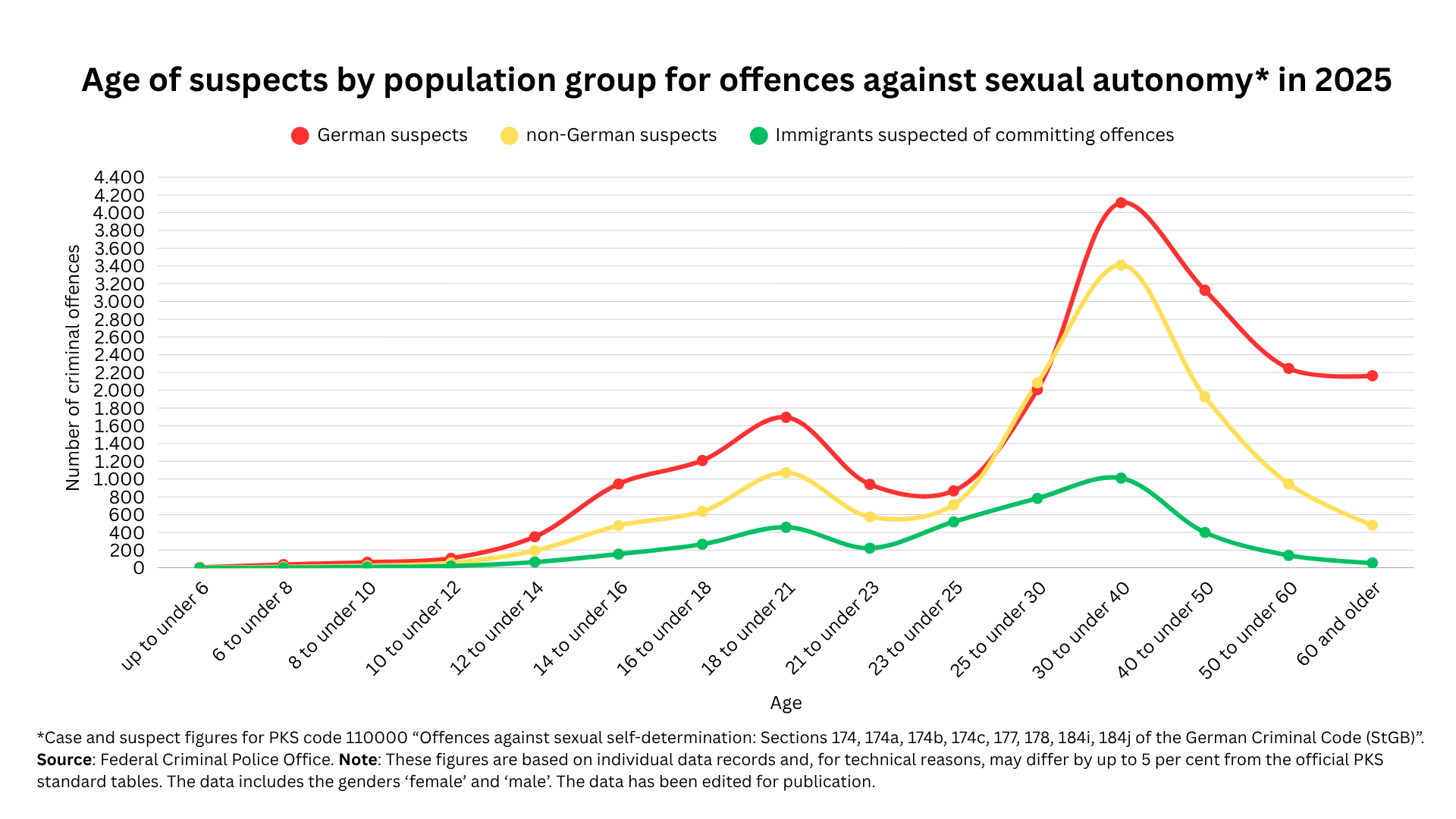
By looking at the age of suspects, conclusions can be drawn about any di erences – or lack thereof – in the propensity to commit violence amongst different sections of the population:
Possible reasons for a tendency to use violence
There are a multitude of possible explanations as to why people are willing to commit acts of violence. People under the age of 30 are considered to be particularly risk-taking, with a strong inclination towards illegal activities. However, the BKA’s analyses also show that many of these individuals are from migrant backgrounds. Heike Fischer, a staff member at the independent women’s refuge ‘Frauen helfen Frauen e.V.’ in Stuttgart, explains that migration is a stress factor that can contribute to violence. This occurs as a result of cultural and social adaptation. Additionally, measures to ensure a livelihood, unemployment or having many children – irrespective of the factor of immigration – can act as stress factors that contribute to violence. This could be seen as a possible reason for the relatively high propensity for violence amongst the group with a migrant background.
Conclusion
The Chancellor claims that the immigrant community accounts for a “significant” proportion of violence in the Federal Republic of Germany. Our fact-check, and an examination of the situation reports and expert statements, do not support this claim. Merz is essentially correct in pointing out that non-Germans also commit a visible proportion of violence against women. However, violence and the breakdown of suspects are complex and multifaceted issues that have been framed too broadly in the debate. By referring to the immigrant community, he is narrowing a problem that affects all groups to a small subgroup within the suspects. The issue is that no classification of the figures recorded – such as the proportion of immigrants in the population or among suspects – was provided. Furthermore, Chancellor Merz provides too little substantive context to give a full picture of the situation. The debate opens up the possibility of future reflection on whether violence can really be linked to a particular culture, or whether violence against women is not rather a cross-group problem amongst men that is relevant to society as a whole. We therefore conclude that Merz’s statement, in the context in which it was made, is largely incorrect.
RESEARCH | ARTICLE © Leonie Bosbach, Philipp Feuerer & Jona Leibing, Stuttgart Media University, Germany
Leave your comments, thoughts and suggestions in the box below. Take note: your response is moderated.