

In an interview with the the newspaper “Frankfurter Allgemeine” on April 27, 2026, German entrepreneur Wolfgang Reitzle takes stock of Germany as a business location. To meet Germany’s electricity needs more affordably, Reitzle proposes a 50:50 mix of renewables and nuclear power. Until new nuclear power plants are built, natural gas power plants should be used. The assumption behind this, which has been proven false: “Germany has large natural gas reserves of its own – enough to last well over 60 years.”
Reitzle considers Germany’s energy policy to be “completely misguided.” He argues that electricity prices in Germany are among the highest in the world, which directly harms the German economy. He blames the high electricity prices on the Greens’ strategy of relying exclusively on solar and wind energy, noting that, after all, wind and sun cannot be controlled. To meet 100 percent of electricity demand from renewable sources by 2035, “complex grids, massive storage facilities, and backup systems” would therefore be needed to compensate for the unpredictability of the weather. Such a system would be “enormously expensive.”
Alternatively, Reitzle proposes meeting 50 percent of electricity demand with nuclear power and 50 percent with renewables. However, he notes that nuclear power is unlikely to gain “majority support” in Germany in the near future. Until “new, safe nuclear power plants” become available, he argues, Germany should therefore “build modern gas-fired power plants equipped with CO₂ capture.” Reitzle justifies this strategy as follows: “Germany has large natural gas reserves of its own – enough to last well over 60 years.” Fracking (hydraulic fracturing) should also be used to extract natural gas reserves.
Germany’s current electricity consumption
To verify Reitzle’s statements, we’ll conduct our own calculations. First, we’ll look at Germany’s electricity consumption. Since, according to Reitzle’s assumption, only half of the electricity demand is to be covered by natural gas, we’ll use half of the annual electricity consumption for the year 2025. That figure was 263 terawatt-hours (TWh). One terawatt-hour is equal to one billion kilowatt-hours (kWh).
Natural gas is typically measured in cubic meters (m³). For rough estimates, a common rule of thumb is that one cubic meter of natural gas is equivalent to about 10 kilowatt-hours of energy. This means that Germany needs 26.3 billion m³ of natural gas per year to meet the aforementioned 50 percent of its national electricity demand.
If you look at the figures for Germany’s current production, there is a huge discrepancy compared to what Reitzle envisions. In 2024, 4.2 billion m³ of natural gas were produced from reservoirs. Assuming a 50:50 mix of renewables and natural gas, this would cover about 16 percent of Germany’s annual consumption at the same production level.
Additional options for natural gas production
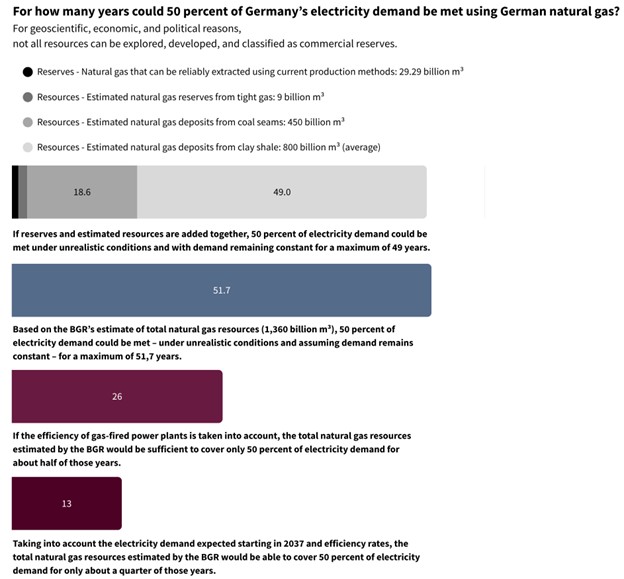
Reservoirs are not the only way to extract natural gas and thereby meet electricity demand. As of December 31, 2025, Germany had natural gas reserves of 29.29 billion m³. Under current conditions, this amount would last for just over a year. These reserves from underground reservoirs represent only a portion of the geological potential.
Natural gas resources in Germany are estimated at a total of 1.36 trillion m³. These consist of 20 billion m³ of conventional natural gas, which can be extracted using currently established technical methods. Additional resources that are currently either not economically viable or have not yet been geologically mapped with sufficient accuracy include: 450 billion m³ of coalbed methane, 9 billion m³ of natural gas from tight gas deposits, and natural gas from shale gas deposits, which range from 300 to 2,000 billion m³ (averaging 800 billion m³).
Definitions: “Reserves” refer to natural deposits of energy sources on Earth that have already been reliably proven to exist and can definitely be extracted. “Resources,” on the other hand, can also refer to the estimated total quantity of a raw material that is not necessarily technically recoverable. This also includes deposits that could only be accessed through fracking.
Assessment of resources
Assuming the full 1.36 trillion m³ of natural gas, this amount would indeed last up to 51.7 years with a 50:50 mix and constant electricity consumption. It is important to note that these figures are only estimates. Furthermore, Germany has a ban on the use of fracking for natural gas extraction from shale, clay, marl, and coal seam rock.
In fracking, a mixture of chemicals is forced into the rock under high pressure to create fractures. This allows previously inaccessible fossil fuels to be extracted. Potential environmental risks include groundwater contamination and the release of methane. “However, even from a purely geoscientific perspective, short- to medium-term exploration or even development of such deposits [shale, clay, marl, and coal seam rock] would not be realistic. It could only take place gradually and would span years to decades,” says geologist Stefan Ladage of the Federal Institute for Geosciences and Natural Resources.
Reitzle considers concerns about fracking as an extraction method to be “completely exaggerated.” He also denounces Germany’s double standard: Germany buys fracking gas from the United States, which “is even more harmful to the climate due to transportation.”
Taking efficiency into account
When converting natural gas into electricity, one must take into account the efficiency of gas-fired power plants. Not 100 percent of the energy content of natural gas can be converted into electricity. In modern gas-fired power plants, 30 – 40 percent of the energy content is lost. Geologist Stefan Ladage estimates the efficiency of average gas-fired power plants at only 50 percent. The other 50 percent of the energy is not completely “lost,” but is partially converted into heat energy. For electricity generation, however, this means that the amount of natural gas required would have to be doubled. In other words, to generate 10 kilowatt-hours of electricity, 2 m³ of natural gas is realistically required. Considering that energy is lost during the conversion of natural gas to electricity, the 1.36 trillion m³ of natural gas (reserves and resources) would only be able to cover 50 percent of electricity demand for about 26 years.
Trends in Electricity Consumption
The 2025 Grid Development Plan projects that Germany’s gross electricity consumption could rise to over 1,000 TWh annually by 2037. The main drivers of this trend are the electrification of applications that have traditionally relied on fossil fuels – including heat pumps, electric mobility, and the transition of industrial processes to electricity – as well as the rising energy demands of digital technologies, particularly data centers for artificial intelligence.
Electricity consumption on this scale would be nearly twice as high as the figure on which our calculations are based. Should this scenario materialize, Germany’s natural gas reserves would be able to meet electricity demand for a significantly shorter period – mathematically, only about half as long as in our scenario.
Conclusion
Wolfgang Reitzle’s statement that Germany has its own natural gas reserves “sufficient for well over 60 years” does not hold up to scrutiny. While Germany’s estimated natural gas resources are theoretically sufficient to cover electricity demand over several years in a 50:50 scenario combining renewables and natural gas, this calculation is based on uncertain resource estimates, assumes the development of previously untapped reserves, and ignores existing legal and technical hurdles – particularly regarding fracking. Furthermore, German electricity consumption is likely to rise significantly in the coming years. Reitzle’s statement must therefore be classified as false: Instead of 60 years, German natural gas could cover at most between 13 and 26 years (depending on the development of electricity demand and the expansion of gas-fired power plants) of Germany’s electricity needs – and even that is rather unrealistic from a geoscientific perspective.
RESEARCH | ARTICLE © Luisa Arnold, Nick Häusler, Leon Meyer & Thalia Pfeiffer, Stuttgart Media University, Germany
Leave your comments, thoughts and suggestions in the box below. Take note: your response is moderated.