
Nigel Farage held a press conference in Westminster on 21 July 2025, which was also published on YouTube by ITV News under the headline “Farage pledges to ‘halve crime in five years’ in law and order speech.” During the conference, he claimed that “The crime survey for England and Wales is based on completely false data.” This statement counters the statistical data from The Crime Survey of England and Wales (CSEW), published by the Office for National Statistics (ONS). Several media outlets had a lot to say about this claim, backing up the CSEW and analyzing the facts surrounding his statements.
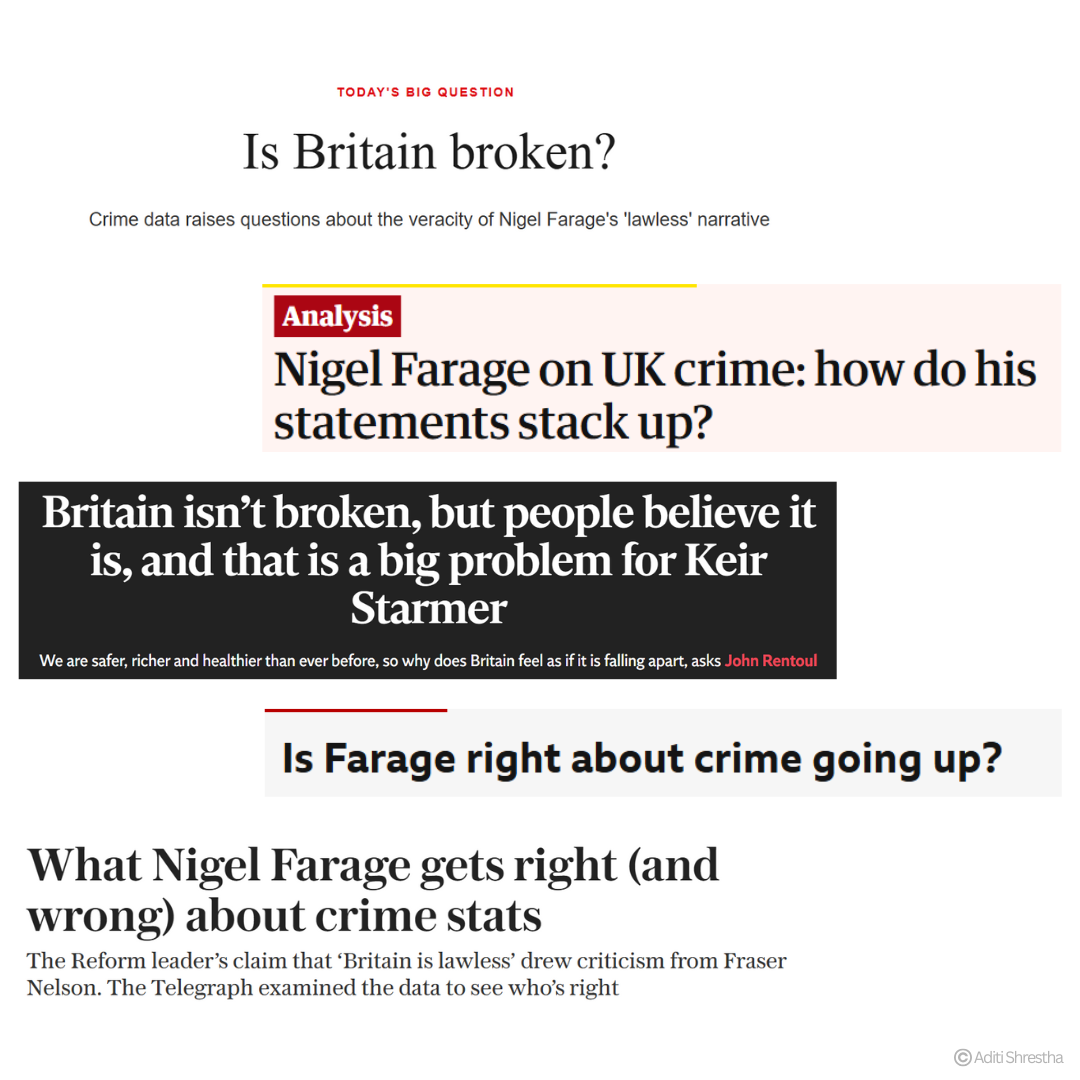
Breakdown of what media outlets have mentioned
The Guardian
The Guardian takes a critical and corrective stance. By directly citing the Office for National Statistics (ONS) and stating that the CSEW is thought to be the most accurate long-term measure of crime because it records incidents that are not reported to the police and is unaffected by changes in recording practices, it refutes Farage’s assertion. The ONS itself views police-recorded statistics as a less reliable indicator of general crime trends, according to the Guardian. The article’s phrasing is factual but subtly critical of Farage, characterizing his assertion as “unclear” in its basis and comparing it with data demonstrating a long-term, overall decrease in crime. The framing implies a focus on protecting statistical integrity and using empirical evidence to refute false information.
BBC
The BBC adopts a more impartial and informative stance. It explains how crime is assessed in England and Wales, differentiating between survey-based and police-recorded data, rather than concentrating on Farage’s rhetoric. According to the BBC, the crime survey is regarded as the most accurate measure of long-term trends and is formally “accredited” by the UK’s statistics body. By highlighting the lack of evidence to support Farage’s claim of “false data,” the coverage gently undermines Farage’s viewpoint without passing judgment. Rather than engaging in political conflict, the overarching framing is one of teaching and explanation, with the goal of assisting readers in understanding methods.
The Independent
The Independent, on the other hand, adopts a more interpretive and opinionated position. Farage’s criticism of the Crime Survey as “discredited” is clearly refuted by its coverage, which explains that the survey’s absence of shoplifting is due to methodological issues—it only questions people about crimes they have directly encountered. In direct opposition to Farage’s portrayal of a “lawless Britain,” The Independent defended the study as “the best and most reliable evidence” of crime trends. Its tone is combative and strong, openly opposing populist data distortions and standing up for institutions run by experts.
The Week (US-based but UK edition)
The Week reported that the public’s view of crime is distorted, as violent crimes are half of what they were 20 years ago. These violent crimes, such as robbery, are down by 60%. In the article, the author quotes another editor, Fraser Nelson, who says, “Our society, for all its faults, is probably safer, richer and better than any before it.”
Even though these statistics are striking, the article notes that the public perception of crime is climbing. Another source in the article, Dominic Lawson, comes to the conclusion, ‘that means Nigel Farage “is the political winner, who plays the ‘broken Britain’ tune to great effect…’”
The Telegraph
The telegraph, a right-leaning publication, frames the debate over crime by contrasting the claim with evidence from the CSEW. The article acknowledges the survey’s limitations, including the exclusion of shoplifting, business crime, and certain vulnerable groups. It presents Farage’s dismissal of the survey as ‘discredited’ as exaggerated and misleading. The Telegraph’s coverage thus balances recognition of Farage’s rhetoric with support for long-term crime trends, reflecting its right-of-center editorial perspective while still relying on official statistics.
Media consensus on Farage’s Claims
Overall, the media outlets that have covered the claims of Nigel Farage have shown that his claims are skewed. While several articles mention that non-violent crime, such as shoplifting, has increased, they stand with the statistics delivered by the CSEW. In consequence to Farge’s claims, he is rallying behind the notion of increased crime, which is misleading to his voters and the general public. The CSEW continues to be a reputable source despite his claims, and should be believed.
International impact of false crime claims
Public perception of crime is not only a hot topic in the UK, but several other EU countries. According to a survey taken by YouGov, “Of the European countries we asked, Swedes are the most likely to think crime is on the rise, at a similar 66% (with just 6% thinking it had gone down). This is despite the fact that crime rates have remained relatively stable over the past 10 years.” Other countries mentioned in the article such as France, Spain, Germany, and the United States, also feel as though crime rates have gone up in their countries. In most of these countries, crime rates have fallen or stayed relatively the same. In Spain, the 2025 crime index score is 35.8, which makes it a “low-crime range” country.
This evidence demonstrates just how damaging false claims of crime statistics can shape public perception and create fear amongst a country’s population. Ultimately, these types of campaigns and statements by prominent politicians and figureheads can lead to distrust in accurate evidence put forward by reputable sources such as the CSEW and the EU commission.
RESEARCH | ARTICLE © Aditi Shrestha, Fenia Rienecker, Hannah Hayes, Subrishti Karki
ILlUSTRATION © Aditi Shrestha
Leave your comments, thoughts and suggestions in the box below. Take note: your response is moderated